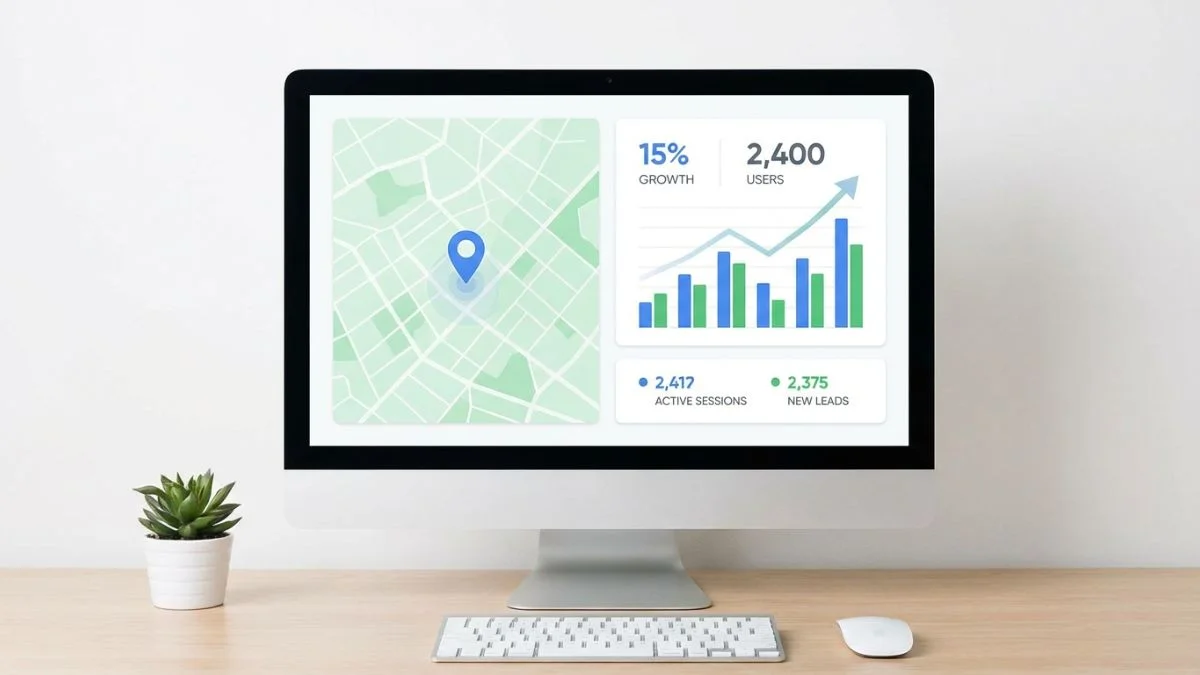
How to Track Local SEO Performance

How to Track Local SEO Performance: The 2026 Analytics Blueprint
Direct Answer: Tracking local SEO performance in 2026 requires a Multi-Surface Attribution Framework. You must synchronize Geo-Grid Rank Data (measuring spatial visibility) with Google Business Profile (GBP) Interaction Signals and UTM-Tagged Conversion Data in GA4. Success is measured by Share of Local Voice (SoLV) and the CPL (Cost Per Lead) Differential between organic local results and paid LSAs. Advanced tracking now includes Entity Sentiment Analysis and Zero-Click Attribution to account for users who convert directly on the SERP.
📊 Executive Summary: The Local Analytics Blueprint
- Spatial Visibility: Beyond single-point tracking; using 13x13 grids to map your Proximity Halo.
- Attribution Hygiene: Implementing UTM parameters for every GBP interaction to eliminate 'Dark Traffic' in GA4.
- Reputation Velocity: Tracking the rate of New Keyword Induction within recent customer reviews.
- Revenue Benchmarking: Calculating the direct ROI of local SEO by contrasting Organic CPL against LSA Auction Costs.
Chapter 1: Beyond Traditional Rankings: The Geo-Grid Paradigm
The most common mistake in local SEO is checking your rankings from your own office desk. Because Google uses your current GPS coordinates to serve local results, your "rank #1" result in your office might be a "rank #15" for a customer three miles away. To truly understand performance, you must utilize geo-grid tracking.
1. Implementing Geo-Grid Reporting
Tools like Local Falcon, BrightLocal, or GeoGrid create a matrix of "pins" over your target city. Each pin simulates a mobile search from that specific geographic coordinate. This results in a "heat map" of your performance.
- Green Nodes (1-3): You are dominating the Map Pack in this area. No immediate action needed.
- Yellow/Orange Nodes (4-10): You are on the "fringes" of the Pack. This is where you focus your optimization effort (reviews and local backlinks).
- Red Nodes (11+): You are invisible. This neighborhood needs targeted localized content or city landing pages.
In 2026, we don't just track rankings; we track "Share of Voice." This metric calculates the percentage of total Map Pack impressions your brand captures compared to your competitors across the entire geo-grid. If you want to know how to track local competitors, SoLV is the ultimate benchmarking metric.
3. Local Analytics Maturity Model (LAMM)
High-performance local brands use the LAMM to audit their data capabilities. Where does your business sit on this spectrum?
| Maturity Level | Tracking Focus | Primary KPI |
|---|---|---|
| Level 1: Reactive | Manual Rank Checking. | Star Rating. |
| Level 2: Standard | Geo-Grid + GBP Insights. | GBP Actions (Calls/Clicks). |
| Level 3: Predictive | GA4 Attribution + SoLV. | CPL Differential vs Paid. |
Chapter 2: Deciphering Google Business Profile Insights
The Google Business Profile (GBP) dashboard provides a wealth of data, but it is often misinterpreted. To track performance effectively, you must look at actions, not just views.
1. Critical Performance Metrics
- Calls: How many users clicked the "Call" button? (Pro-Tip: Match this against your actual call logs to see the "Google GAP" where users dial manually instead of clicking).
- Directions Requests: The strongest signal of high-intent "near me" traffic. A direction request almost always correlates with a physical visit to your store.
- Website Clicks: High-intent traffic that is often ready to convert via a form fill.
- Messages: If you have GBP Chat enabled, tracking response time and lead volume here is vital for conversion optimization.
2. Navigating the "Search Queries" Report
Google provides a list of specific search terms that triggered your profile. Use this data to inform your on-page strategy. If you see a high volume of impressions for a service you haven't optimized for (e.g., "emergency AC repair"), it's an immediate signal that you should know how to use local keywords for SEO by expanding that specific service page on your site.
Chapter 3: Local Conversion Attribution with UTM Parameters
By default, traffic from your Google Business Profile shows up in Google Analytics as "organic search," indistinguishable from regular website traffic. This makes it impossible to calculate the specific ROI of your local SEO efforts. You must use UTM parameters to bridge this "dark traffic" gap.
1. Tagging Your GBP URLs
Instead of linking to yourwebsite.com, append a UTM string to your GBP website link:
yourwebsite.com/?utm_source=google&utm_medium=organic&utm_campaign=gbp_listing
When you do this, you can open Google Analytics 4 (GA4) and see exactly how many goal completions (leads, sales) originated specifically from your Map Pack listing.
2. Tracking Google Posts Performance
As covered in how to use Google Posts for local SEO, every post has a "Learn More" or "Book" button. You should use unique UTMs for these as well (e.g., utm_content=post_june_sale) to see which types of updates drive the most conversions.
Chapter 4: Measuring Reputation Momentum (Review SEO)
Reviews are not just for social proof; they are a primary ranking factor. Tracking your review velocity and sentiment is a core part of local SEO performance reporting.
1. Review Velocity Tracking
How many reviews are you getting per month? If your top competitor is getting 10 reviews a month and you are getting 2, they will eventually overtake you due to "freshness" signals. You must track your acquisition rate to know if you need to double down on how to optimize online reviews for SEO.
In 2026, we don't just look at the star rating. We look at "Keyword Injections." Are customers using your target keywords (e.g., "best plumber") in their reviews? Search engines crawl this text. Periodically audit your reviews to see if your customer coaching and service delivery are resulting in keyword-rich feedback.
1. The Attribution Scorecard (TAS)
Use the TAS to ensure that every local lead is correctly attributed to the right channel, preventing "Dark Traffic" from skewing your ROI data.
| Interaction Type | Tracking Method | Accuracy Level |
|---|---|---|
| GBP Web Click | UTM-Tagged URL (Source=GBP). | 99% (GA4). |
| GBP Phone Call | DNI (Dynamic Number Insertion). | 95% (Call Tracking). |
| Map Pack Visit | Store Visit Conversions (Google Ads). | ~85% (Probabilistic). |
As we explored in online review optimization, the synergy between review velocity and conversion tracking is what separates the market leaders from the also-rans.
Chapter 5: Technical Tracking: Search Console and GA4
While the Map Pack is vital, you must still track your organic website performance, especially your how to optimize local landing pages across different cities.
1. Filtering for Local Intent in GSC
Use "Query" filters in Google Search Console to isolate local searches. Filter for terms containing your city name or "near me." Track the CTR (Click-Through Rate) of these local queries. If your rankings are high but your CTR is low, your Meta Titles or Descriptions are likely not appealing enough to the local consumer.
2. Tracking Page Experience and Core Web Vitals
Performance tracking includes technical health. If your site speed degrades, your local rankings will follow. Meticulously track your site's health according to how to reduce page load time for SEO. If your Largest Contentful Paint (LCP) spikes above 2.5 seconds, you are at risk of losing "near me" voice search traffic.
Chapter 6: Competitive Benchmarking: Knowing Your Enemy
Local SEO is a zero-sum game. If you go up, someone else must go down. Tracking your performance in isolation is a mistake; you must track your performance relative to your competitors.
1. The Citation Gap Audit
Every six months, run a citation audit to see where your competitors have secured links that you haven't. If they have links from the local high school boosters or the city chamber that you lack, they have an authority advantage. This is the foundation of how to build local backlinks strategy.
2. Tracking Competitor GBP Updates
Are your competitors posting on Google 3 times a week while you post once a month? Are they uploading 10 new photos a week while your profile stays static? Tracking their "Activity Score" is a leading indicator of who will win the long-term Map Pack battle.
Chapter 7: Reporting Local SEO ROI to Stakeholders
If you are an agency or a marketing manager, "rankings" are a hard sell. Businesses care about revenue. Your reports must translate SEO metrics into dollar amounts.
1. Calculating Cost Per Lead (CPL)
Take your total monthly investment in local SEO (software, content, agency fees) and divide it by the total number of conversions tracked (Calls + Form Fills + Direction Requests). If your local SEO CPL is $20 and your Google Ads CPL is $80, you have a powerful case for increasing your SEO budget.
For franchises or regional chains, tracking becomes exponentially more complex. You must utilize "Level 3" reporting dashboards (like Looker Studio or specialized multi-location tools) to see which stores are dominating and which stores are lagging. Understanding how to manage local SEO for multiple locations requires a bird's-eye view of your entire geographic footprint.
Chapter 8: Zero-Click Attribution: The Invisible Conversion
In 2026, over 60% of local leads never reach your website. They convert in the Zero-Click Zone—directly on the Google Local Pack. To track these, you must monitor GBP Messaging Leads, Q&A Interactions, and Photo View Velocity. Google's algorithm treats high engagement on your profile as a strength signal. If your 'Directions' requests are high but your 'Website' clicks are low, you aren't failing—you are simply winning in the Zero-Click economy. See our guide on local schema implementation to maximize your profile's 'Richness' and drive these invisible conversions.
Conclusion: Data-Driven Dominance
Tracking local SEO performance in 2026 is no longer about checking a single number. It is about triangulating data from geo-grids, GBP insights, UTM-tagged analytics, and technical health audits to form a complete picture of your digital footprint.
By moving beyond the simplistic "what's my rank" mentality and embracing deep-diver attribution and competitive benchmarking, you gain the "unfair advantage." You can stop guessing what works and start investing with surgical precision in the tactics that drive the most directions, the most calls, and the most revenue for your business. In the hyper-competitive local landscape, the brand with the best data is the brand that inevitably wins the market.
Frequently Asked Questions on Local SEO Tracking
1. Why is my ranking different when I search from my office vs. my home?
Google results are hyper-localized based on your device's current GPS coordinates or IP address. For local service queries, every hundred yards can change the Map Pack order. This is why you must use geo-grid tracking tools rather than manual searches to see your true performance.
2. What is geo-grid rank tracking?
Geo-grid tracking creates a map of "pins" over a city. It simulates a search from each pin to see exactly where your business ranks in the Map Pack throughout the region. This visualization shows you exactly where your "visibility radius" begins to drop off, allowing for targeted local optimization.
3. How do I track how many phone calls come from local SEO?
You can see basic "Click-to-Call" numbers in your Google Business Profile Insights. For more precision, use a Call Tracking Number (like CallRail) specifically on your GBP and local landing pages. This allows you to record calls and attribute them directly to your SEO campaign.
4. What are UTM parameters and how do they help local SEO?
UTM parameters are tags you add to your website link in your Google Business Profile. They tell Google Analytics that a visitor came from your "Map Pack" listing rather than a regular "Organic" search result. This is the only way to accurately track goal conversions from your Maps profile.
5. Are "Views" in Google Business Profile a good metric to track?
No. "Views" are a vanity metric. A view could mean someone just scrolled past your listing while looking for something else. You should focus on "Actions" (calls, direction requests, website clicks) as these represent high-intent users taking the next step in the buyer journey.
6. How do I track my competitors' local SEO performance?
You use geo-grid tools to compare your heat map against theirs. You should also monitor their "Review Velocity" (how many reviews they get per week) and their "Posting Frequency" on Google Posts. If they are more active than you, they will likely eventually outrank you.
7. How does Page Speed impact my local SEO tracking?
Page speed (Core Web Vitals) is a known ranking factor. If your tracking shows your rankings are slipping even though your NAP and reviews are good, check your site speed. A slow site can kill your visibility in "near me" voice searches and mobile pack results.
8. How do I track Local SEO for multiple locations?
You must use an enterprise dashboard (like Looker Studio) to aggregate data from all your Google Business Profiles. This allows you to see which locations are underperforming relative to the others so you can distribute your marketing resources more effectively.
10. How often should I run a local SEO performance report?
For most small businesses, a monthly deep-dive report is sufficient. However, you should check your "GSC Health" weekly to ensure there are no indexing errors or speed issues that could cause a sudden, catastrophic drop in local rankings.
11. What is 'Proximity Halo' and how do I measure it?
The Proximity Halo is the maximum geographic radius where your business ranks in the top 3. You measure it by analyzing the 'drop-off point' on a 13x13 geo-grid tracking report.
12. How do I track voice search performance for local queries?
Voice search is often 'Zero-Click.' Monitor your GBP 'Direction Requests' and 'Calls' volume as proxies, as these are the most common outcomes of a localized voice search (e.g., 'Siri, find a plumber near me').
13. What is the 'GSC-GBP Gap' in data?
The numerical difference between clicks reported in Google Search Console and actions reported in GBP Insights. High GSC clicks with low GBP actions suggest your landing page is great but your Maps profile is unoptimized.
14. How do I track the ROI of 'Google Posts?'
Use unique UTM parameters for every post (e.g., utm_content=post_id). This allows you to track specific sales or leads back to an individual update in GA4.
15. Does 'Freshness' of reviews affect tracking?
Yes. Review Velocity (the rate of incoming reviews) is a dynamic ranking factor. A competitor with fewer but fresher reviews can outtrack a legacy business with 1,000 stale reviews.
16. How do I attribute 'Foot Traffic' to SEO?
Use Google's 'Store Visit' conversions (available in some industries) or track 'Direction Requests' as a 1:1 proxy for intent to physically visit.
17. What is 'Sentiment Decay' in reporting?
The rate at which older positive reviews lose their algorithmic weight as newer negative or neutral reviews appear.
18. How do I track 'Service-Area' visibility without a storefront?
Use grid tracking specifically for your service radius. Focus on 'Heat Map' expansion in neighborhoods where you haven't yet established a content silo.
19. Impact of 'WebP' on local tracking metrics?
Image speed affects LCP (Largest Contentful Paint). If your competitor's images load faster via WebP, they may win the 'Near Me' tie-breaker in high-competition areas.
20. How to track 'Keyword Injection' in user reviews?
Audit your reviews for bolded keywords in Google's UI or use sentiment analysis tools to see which products/services customers mention most frequently.
21. What is 'Direct vs Discovery' search in GBP?
'Direct' means they searched for your brand name. 'Discovery' means they searched for a category (e.g., 'Hotel'). Tracking the ratio helps determine your SEO brand reach.
22. How do I track 'LSA Impression Share?'
Monitor how often your Local Service Ads appear in the top 3 paid slots compared to your top 5 organic competitors.
23. What is 'Local Intent Polarization?'
When competitors target different intents for the same local keyword (e.g., 'Emergency Repair' vs 'Free Estimate'). Track which intent converts higher.
24. How to measure 'Entity Trust' in local SEO?
Check your brand's presence in high-authority local datasets like the Chamber of Commerce, legacy news sites, and government registries.
25. Impact of 'Dark Traffic' on local reporting?
Untagged GBP traffic often appears as 'Direct,' hiding the true value of your SEO. UTM tagging is the only cure for dark traffic.
26. How to track 'Review Response Velocity?'
Measure the average time from review posting to your response. Google sees rapid engagement as a signal of an active, reliable business.
27. What is 'Spatial Rank Drift?'
When your ranking moves slightly every day due to algorithmic testing or competitor updates. Weekly averaging is more reliable than daily checks.
28. How do I track 'Unstructured Citations?'
Use brand monitoring tools to find mentions of your business on local blogs or social groups that don't include a direct link.
29. Impact of 'NAP Consistency' on tracking?
Inconsistent data causes 'Trust Friction' in the algorithm. Track your 'Listing Health Score' across the top 50 local directories.
30. How to monitor 'Competitor GBP Edits?'
Use tools that alert you when a rival changes their primary category, business name, or service list.
31. What is 'Local Conversion Rate Optimization' (LCRO)?
Tracking how changes to your GBP (new photos, better descriptions) actually drive more 'Actions' from the same number of 'Views.'
32. How to track 'Visual Search' for local products?
Monitoring how often your GBP photos appear in Google Lens or 'Image' results for hyper-local product queries.
33. Importance of 'Historical Rank Comparison?'
Comparing today's heat map to 12 months ago to identify 'Seasonal Visibility' patterns in your industry.
34. How to budget for 'Predictive Tracking?'
Allocating 10% of your SEO budget to advanced analytics tools that forecast competitor moves and market shifts.
35. What is the 'Data-First' local SEO mindset?
The philosophy of never making a tactical change (e.g., rewriting a city page) without first having at least 90 days of baseline performance data.